SEO vs AEO: What Actually Changed When Search Started Answering
What changed when Google and ChatGPT started answering, what Google says still counts, and the five steps that move an SEO program toward AEO.
On this page
Search is still one of the cheapest ways for a software company to find buyers. A page that ranks for the right question can bring in customers for years.
That page now shares the results with an answer. Google says AI Overviews reach more than 2.5 billion people a month, and AI Mode has passed a billion. ChatGPT, Perplexity and Gemini answer the same questions directly, often before anyone sees a link.
If you have opened Search Console lately, you may have seen impressions hold while clicks slide.
But every agency pitch now arrives with a new acronym. In the SEO vs AEO debate, one camp says SEO is dead and AEO replaces it. The other says AEO is SEO with a new invoice. Rebuilding everything throws away a program that still works, while changing nothing leaves you chasing clicks that keep shrinking.
So is AEO a real shift or a new label, and what should you do differently?
I went through the top-ranking guides, Google's own documentation and the click studies from Pew, Ahrefs and Seer to find out. I also build LinkGecko, a link intelligence tool for software companies, so I have a stake in part of this answer.
SEO vs AEO: the quick answer
- SEO earns your page a ranked link on a results page. You win a click.
- AEO, answer engine optimization, earns your brand a mention or a citation inside an AI answer in Google's AI Overviews, ChatGPT, Perplexity or Gemini. You win a recommendation, sometimes with no click at all.
- GEO, generative engine optimization, is the same goal under the name researchers gave it. SEO vs GEO is the same comparison as SEO vs AEO, so treat AEO and GEO as one practice.
- What stayed the same: Google says optimizing for its AI search is "optimizing for the search experience, and thus still SEO." Crawlable, useful pages that rank remain the base.
- What changed: fewer clicks per search, answers that shift every time someone asks, and more weight on the pages other people write about you.
What is AEO, and where does GEO fit?
AEO, answer engine optimization, is the work of getting your brand named or cited when Google's AI, ChatGPT, Perplexity, Claude or Copilot answers a conversational question. When a buyer asks which tool to use, the assistant writes a reply and names a few brands and sources. The term grew up around featured snippets and voice answers, and now covers full AI answers.
SEO, search engine optimization, is the work of ranking a page in Google or Bing for the searches your buyers make. The levers are content that matches search intent, a technically healthy site and backlinks from other sites. Success is a position on the SERP and the organic traffic that follows.
GEO comes from a 2023 paper by Pranjal Aggarwal and co-authors, later accepted at KDD 2024, which tested how content changes affect visibility in AI-generated answers. Teams now use AEO and GEO for the same work, so the label matters far less than the practice.
What changed when search started answering
Pew Research Center tracked 68,879 real Google searches. People clicked a regular result in 8% of visits when an AI summary appeared, against 15% when none did. They clicked a link inside the summary in just 1% of visits.
SEOs call searches that end without a site visit zero-click searches. Pew found people ended their session on 26% of pages with an AI summary, against 16% without.
Larger datasets point the same way. Across 300,000 keywords, Ahrefs linked an AI Overview to a 58% lower average click-through rate for the top-ranking page. Seer Interactive measured organic click-through on informational queries with an AI Overview falling 61% over fifteen months.
Google disputes the scale. Liz Reid, who leads Google Search, wrote in August 2025 that total organic clicks had been "relatively stable year-over-year." Both can be true if quick informational searches lose clicks while research and buying searches keep sending visits.
Brands inside the answer appear to do better. Seer found brands cited in an AI Overview had a 35% higher organic click-through rate than brands left out. Seer notes it cannot prove the citation caused the lift.
What didn't change: Google still calls it SEO
In May 2026, Google published a guide to optimizing for its generative AI features. It says there's no special schema.org markup to add, no need for AI text files, and no requirement to break content into tiny pieces.
What still counts is ordinary search work. That means pages Google can crawl and index, content that answers a real question better than the alternatives, and links and mentions from sites people trust.
Google does document one new mechanism, query fan-out. AI Overviews and AI Mode may split one question into several related searches, then build the answer from pages that rank for those smaller searches.
So a page ranking for "CRM pricing for startups" can feed an answer to "best CRM for a startup" without ranking for the broad query.
Google's guidance covers Google only. ChatGPT search finds pages through OpenAI's own crawler, OAI-SearchBot, and OpenAI says sites that block it won't be shown in ChatGPT search answers.
The part rankings miss: pages other people write
When someone asks an assistant for the best tool for a job, the answer tends to lean on pages other people wrote. Think review sites like G2 and Capterra, best-of lists, comparison posts and forum threads. Pew found Wikipedia, YouTube and Reddit alone supplied 15% of the sources in Google's AI summaries. For software questions, Ahrefs found best-of lists make up 43.8% of the pages ChatGPT draws on.
A brand can rank well and still go unrecommended. When the five pages behind an answer all list your competitors and leave you out, the answer tends to do the same.
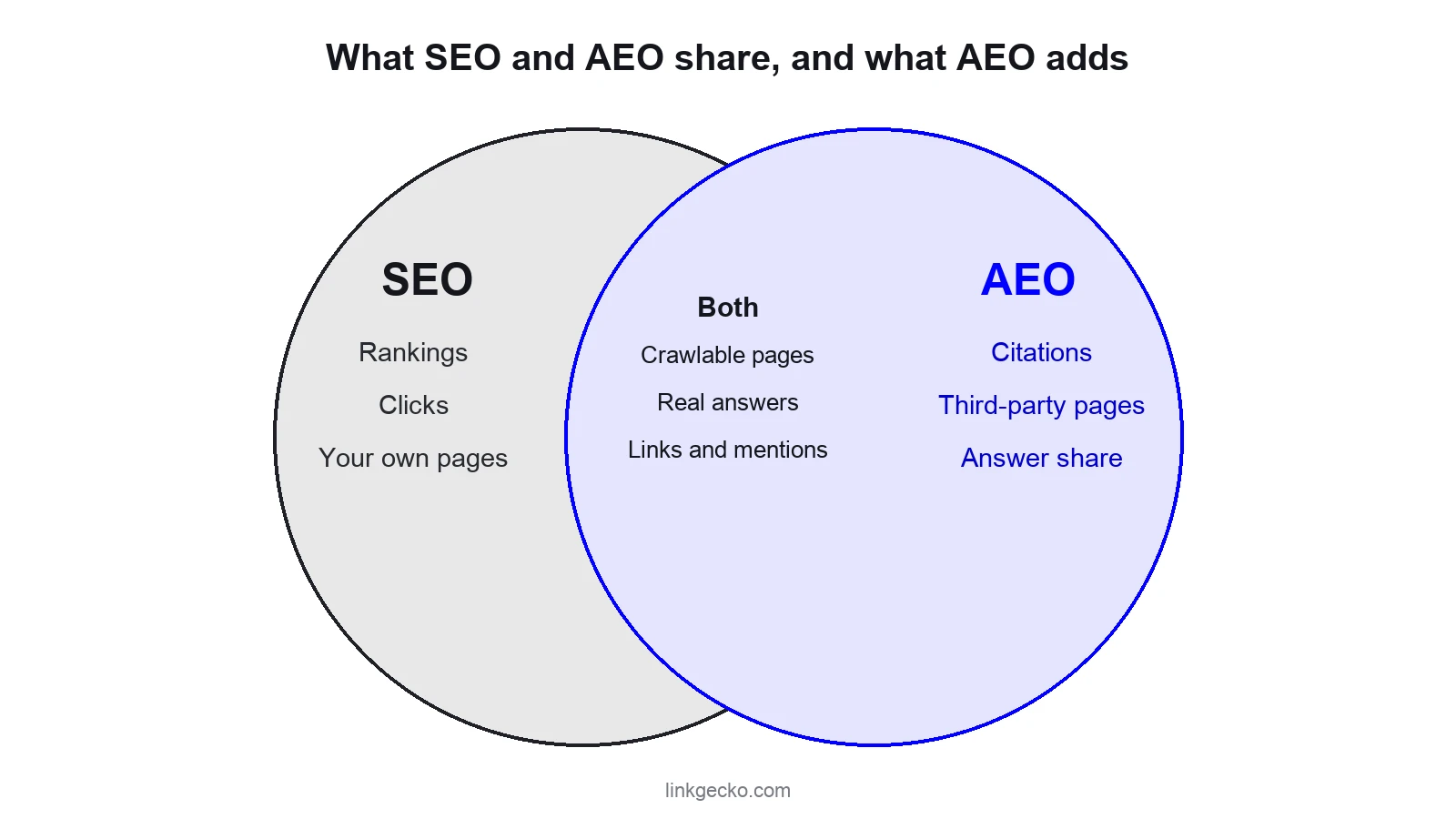
SEO lets you win with your own page. AEO also needs brand mentions on pages you don't control, so earning those placements, which is link building, moves back to the center.
Buying your way onto them helps less than it looks. Google's guide warns that "seeking inauthentic 'mentions' across the web isn't as helpful as it might seem."
Don't get too excited when ChatGPT names you
The first time you see your brand in a ChatGPT answer, it feels like proof. It may be. It may also be one lucky draw.
AI answers are written fresh each time. SparkToro and Gumshoe ran the same prompts 2,961 times to see how stable the recommendations were. Even the leading headphone brands appeared in only 55% to 77% of responses.
Under 1 in 100
The chance ChatGPT or Google's AI returned the same list of brands twice for the same prompt (SparkToro and Gumshoe).
A 2026 paper on measuring visibility in AI search reaches the same conclusion. Answers "can vary across runs, prompts, and time," so one observation tells you little.
The number worth tracking is how often you're named across many asks. Call it answer share, or share of voice in AI answers. Being named in 3 of 10 runs this month and 6 of 10 next month is progress you can trust.
How to move from SEO to AEO, step by step
- Keep the SEO basics working. Your pages should be crawlable, indexed and fast. Check that robots.txt and your CDN let Googlebot, Bingbot and OAI-SearchBot through, since a crawler that can't read a page can't cite it. OpenAI uses OAI-SearchBot for ChatGPT search and GPTBot for model training, so you can block training without leaving search.
- Put the answer first. Under each question-style heading, answer in the first two sentences, then add the detail. Readers get what they came for, and an assistant gets a clean passage to quote.
- Cover the questions around the question. Buyers ask about pricing, alternatives, comparisons and integrations on the way to a decision. With fan-out, pages that rank for those can feed the main answer.
- Find the pages the answers cite, then get onto them. Ask your buying questions in ChatGPT, Perplexity and Google, list every cited page, and mark the ones that name competitors and not you. That list is your link plan. LinkGecko runs this research for a category and ranks the gaps by how often each page is cited.
- Measure share, not position. Fix a set of about twenty buying questions, ask each several times a month, and log who gets named. For Google, add Search Console's Generative AI performance report, which shows how often links to your site appear in its AI features. It counts impressions, not clicks.
What to stop spending on
- FAQ and HowTo structured data as an AEO tactic. Google limited FAQ rich results to government and health sites in 2023 and retired HowTo results, and its AI guide needs no special markup. Accurate product and organization markup still helps search engines read the page.
- llms.txt as a ranking lever. Google Search ignores it, so it won't move your Google visibility either way.
- Voice search as its own project. A clear answer to a real question already serves a spoken query.
- Tools that report an "AI ranking position." Answers change on every run, so a single position is a snapshot of one draw. Rand Fishkin calls such tools "full of baloney."
So, is SEO dead?
No. AI answers are built from pages that get crawled, indexed and ranked, so the program you have still carries the weight.
A click is no longer the only win, one answer proves very little, and pages other people write about you now count alongside your own. Teams that keep their SEO and add third-party placements and repeated measurement cover both kinds of search.
The most useful first move is listing the pages AI answers cite for your most valuable buying question, and getting onto one of them.
Frequently asked questions
No. Google calls AI optimization part of SEO, and AI answers draw on pages that already rank. AEO adds earning placements on third-party pages and tracking how often you are named across repeated answers.
Mostly the name. GEO, generative engine optimization, comes from a 2023 research paper, while AEO, answer engine optimization, grew out of featured snippets and voice answers. Both mean earning mentions and citations inside AI-generated answers, and the work is the same.
No. Google says there is no special schema.org markup to add for its AI features, and structured data is not required. Accurate product and organization markup still helps search engines understand a page, but it will not get you cited on its own.
You can ask the same buying question in several new chats and count how often your brand is named, because answers change from run to run. Tracking that share on a fixed set of questions shows real movement. For Google, Search Console's Generative AI performance report shows how often links to your site appear in its AI features.
A small team gets the most from SEO first, since AI answers draw on it. The next step is getting onto a page AI answers cite for your top buying question, which is link building work.
Not in Google. Google says its Search ignores llms.txt files, so adding one will neither help nor harm your Google visibility. Your time is better spent on crawlable pages and on the third-party pages AI answers already cite.
See which links decide your category
LinkGecko maps the links behind your category's AI answers and helps you build yours, from $19 a month.
Start your free trial