Link Building Agency vs DIY Link Building for SaaS: The Real Cost of Every Live Link
Agency, DIY, an in-house hire or software: what each route costs per live link, from 2026 pricing, reply-rate and salary data.
On this page
Links remain one of the few assets a SaaS company can build once and benefit from for years. A placement on the right review site or best-of list keeps sending buyers long after the work is done. It now also shapes the answers ChatGPT and Perplexity give when someone asks for a tool like yours.
Software buyers often do their research on AI assistants before buying. For software queries, "best X" lists alone make up 43.8% of the pages ChatGPT draws on, according to Ahrefs.
But link building can be expensive. Agency retainers run anywhere from $1,000 to $20,000 a month. If you cannot see what the agency is doing with that money, the links it delivers can turn out to be worthless.
DIY link building is cheaper, but it can be painful and overwhelming. Hours of research go into emails that nobody answers. Nothing tells you whether the few links you do land are the ones that matter.
So, link building agency vs DIY: which one actually gets a SaaS company onto the pages buyers and AI answers read, without burning the budget or the team?
I costed each route from the published pricing studies, reply-rate datasets and salary data. I also built LinkGecko to make the DIY route workable, so I have a stake in this answer.
Link building agency vs DIY for SaaS: the quick answer
- Agency: $2,500 to $10,000 a month, roughly $250 to $1,250 per link on a typical retainer. You buy capacity and relationships you do not keep.
- DIY: about $190 to $565 of your own time per live link at a US specialist's hourly rate, plus whatever tools you use. Every relationship stays with you. Budget about 35 hours per hundred emails.
- In-house hire: about $7,700 a month fully loaded with tools, and a ramp of several months by agencies' own estimates. Worth it once an agency bill sustains $8,000 a month.
- Software-assisted DIY: $19 to $297 a month for the target list and the drafts, sent under your name. The lowest cost per attempt for most SaaS teams needing under ten links a month.
What a link building agency sells you for $2,500 to $10,000 a month
An agency retainer buys a quota of placements, a team that already knows which sites say yes, and a monthly report. BuzzStream's review of published agency pricing puts retainers between $2,500 and $10,000 a month. The most common tier is $2,500 to $5,000 for roughly four to ten links.
That works out to $250 to $1,250 a link before you know what the links are. Per-link editorial placements from agencies run $600 to $1,500. Digital PR, where the agency pitches journalists with original data, averages $597 a link on a $5,458 monthly contract.
Where the links come from decides whether the price is fair. When an agency's placements are guest posts or insertions bought from site owners, you pay the resale markup. BuzzStream priced the same guest post at $295 bought direct and $461 through a vendor, about 56% more.
Of the guest post sites BuzzStream reviewed, 1.37% met its quality bar, and about 2% of link insertion offers did. An agency earns its fee by sorting that pile for you. A weak one forwards the pile to your reporting dashboard.
Among in-house marketers who use external link builders, 30% are fully confident in the results, according to BuzzStream and Citation Labs' 2025 link building survey. Only 29% of all respondents call their link programs successful.
Contract terms shape the rest of the cost. About 75% of digital PR contracts run longer than six months. Roughly half of agencies guarantee a number of links. A volume guarantee is easy to meet with cheap placements, so the useful guarantee names the domain rating and traffic floor each link must clear.
Checking three sample placements before signing tells you more than the pitch deck. A page that carries real traffic, appears in AI answers for your category, and was not bought from a "write for us" marketplace is worth paying $600 for. One that fails all three is a $295 guest post with a markup.
An agency is the right buy when you need more than about ten quality placements a month and nobody on your team can hold the outreach hours. It also fits when you want original research pitched to journalists at scale. Outsourcing link building at that volume pays for speed you would struggle to match alone.
What DIY link building costs once you count the emails nobody answers
Doing it yourself looks free because no invoice ever arrives. The cost hides in hours, and the hours multiply because most emails fail.
Across 51 million outreach emails, BuzzStream measured a 3.59% reply rate for link building pitches, or one reply for every 28 sent. The median across 12,000 campaigns sits higher, at 12%, with the top quartile clearing 20%. Relevant personalization adds about 10.7 points, while fake personalization subtracts.
Only around half of replies turn into a live placement after the editor's requests, revisions and silence, in my experience. So 100 well-personalized emails produce somewhere between two and six live links.
Researching the page, finding the editor, reading what they already list and writing a pitch that names it takes about 15 minutes per email. At that pace, 100 emails take 25 hours. One follow-up on everyone who ignored you adds about five hours. Follow-ups lift replies by 65.8%, per Backlinko's 12-million-email study, so skipping them is expensive.
Handling the replies and getting each link placed adds roughly five more hours. Call it 35 hours per 100 emails. At the $32.31 hourly rate ZipRecruiter reports for a US link building specialist, that is about $1,130 of labor.
Divided by two to six live links, each one costs you $190 to $565 of your own time. Editorial.Link's survey quotes a practitioner estimating 10 to 15 hours per high-authority link, which lands in the same range.
$190 to $565
Your own time per live link: 35 hours at $32.31 an hour, across two to six links.
DIY beats the agency's $250 to $1,250 a link only when your reply rate is average or better. It also assumes your hour is worth no more than a specialist's, which is rarely true for a founder.
Targeting fewer, better pages raises the reply rate, because editors answer pitches that fit. A tight list also cuts the research hours, since you are reading twelve pages properly instead of skimming two hundred.
Tooling is the smaller cost. A backlink index like Ahrefs starts at $129 a month, and an outreach tool adds $50 to $200. Both are optional at under ten links a month if you already know which pages to pitch.
DIY also gives you something money cannot buy. The Zapier writer or the TechRadar editor now knows your name, so the second placement with them usually costs a fraction of the first.

The in-house hire: the most expensive way to start
Hiring a link builder feels like the grown-up version of DIY. For the first several months, it is the costliest route per link by a wide margin.
ZipRecruiter puts the average US link building specialist at $67,214 a year as of 25 October 2026. Benefits, payroll taxes and management time push the loaded cost to roughly $87,000. Tools add $350 to $650 a month for Ahrefs or Semrush plus an outreach platform, by Discovered Labs' estimate. The function costs about $7,700 a month before a single link lands.
Agencies that sell against in-house teams put the ramp at four to six months before the first quality link. The figure is theirs, but the mechanics behind it hold: prospect lists, templates and publisher relationships all start from zero. Four months at $7,700 for a handful of placements puts the first links at several thousand dollars each.
Once the hire is producing 10 to 20 links a month, the cost lands at $385 to $770 a link. That sits inside a mid-tier agency's range rather than below it, so the hire does not win on price alone. It wins on ownership: the relationships and the prospect pipeline stay inside the company.
Turnover rarely makes it into the budget. When a link builder leaves, the editor relationships and the knowledge of who replies walk out too. Discovered Labs estimates replacement at $20,000 to $40,000 in hiring and retraining, followed by another ramp.
An in-house hire makes sense once an agency bill has run at $8,000 a month or more for six months. That is close to the $8,406 average minimum monthly budget Editorial.Link's 2026 survey found for competitive niches.
At that spend, a loaded salary costs about the same and the relationships become yours.
The pages that decide which SaaS gets recommended
Every cost above assumes the links point somewhere useful. For SaaS in 2026, useful means the pages AI assistants read before they name a tool.
Ahrefs analyzed 26,283 source URLs behind ChatGPT answers to software queries. Best-of lists made up 43.8% of the page types cited, and 35% of those lists sat on low-authority domains. More than a quarter of ChatGPT's most-cited pages have no Google organic visibility at all.
A low-authority best list that ChatGPT reads is worth more to you than a DR 70 guest post nobody opens. That inverts how most agency tiers are priced, since they run on domain rating.
Of ChatGPT's top 1,000 cited pages, Ahrefs found only 32.3% are realistic outreach targets. The median cited page has a domain rating of 90, and three quarters were updated in the prior six months. Wikipedia alone is more than half the sample.
For a SaaS category, the winnable set is usually short. It includes the G2 and Capterra category pages, two or three "best X software" roundups on publisher blogs, and a handful of "alternatives to [market leader]" posts.
The Reddit threads where buyers ask for recommendations belong on it too. Visible's study of B2B SaaS prompts found G2 cited across 79.2% of categories.
The mix is moving. Seer Interactive tracked a 30% drop in listicle citations in ChatGPT from December 2025 to January 2026.
Discovered Labs' retrieval research, which comes from an agency, shows documentation pages rising to over half of ChatGPT citations in a B2B SaaS prompt set. That covers October 2025 to August 2026. Both are single studies, but they point the same way: thorough pages on your own domain count alongside third-party lists.
Mentions matter more than links. Ahrefs' study of 75,000 brands found branded web mentions correlate 0.664 with AI Overview visibility, against 0.218 for backlinks. LinkGecko's 113 Signals report grades the evidence behind each signal in that literature, and the correlation studies it reviews put mentions well ahead of links.
The target list for a SaaS category is specific, knowable and small. Volume pricing assumes more links always help. Getting named in AI answers usually comes down to a dozen conversations with the right editors.
A third route: software finds the targets, you keep the relationship
Between a retainer you cannot see inside and a weekend of unanswered emails sits a model priced per action rather than per link. Software identifies which pages AI answers cite for your buyer questions and drafts the pitch for each one. You send it from your own inbox.
That split removes the two parts of DIY that cost the most hours: finding the right pages and writing the first draft. It keeps the part that compounds, which is the editor knowing you.
LinkGecko does this for software companies from $19 a month. You add your domain and category, and it asks AI the questions your buyers ask.
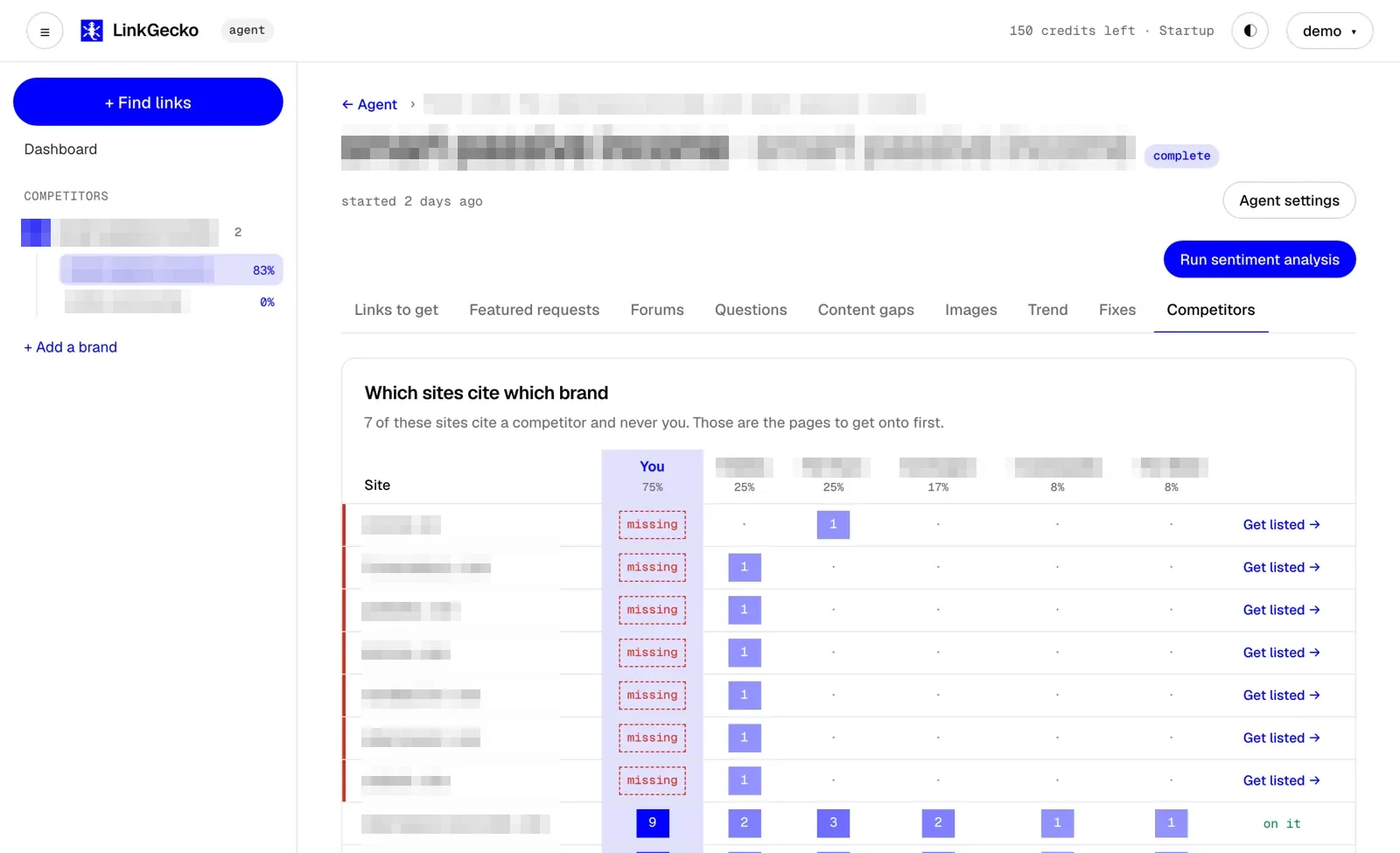
It then ranks the review sites, roundups and threads behind each answer by how often AI answers reference them. For each one it drafts an email to the editor that names the question their page answers and the tools it already lists.
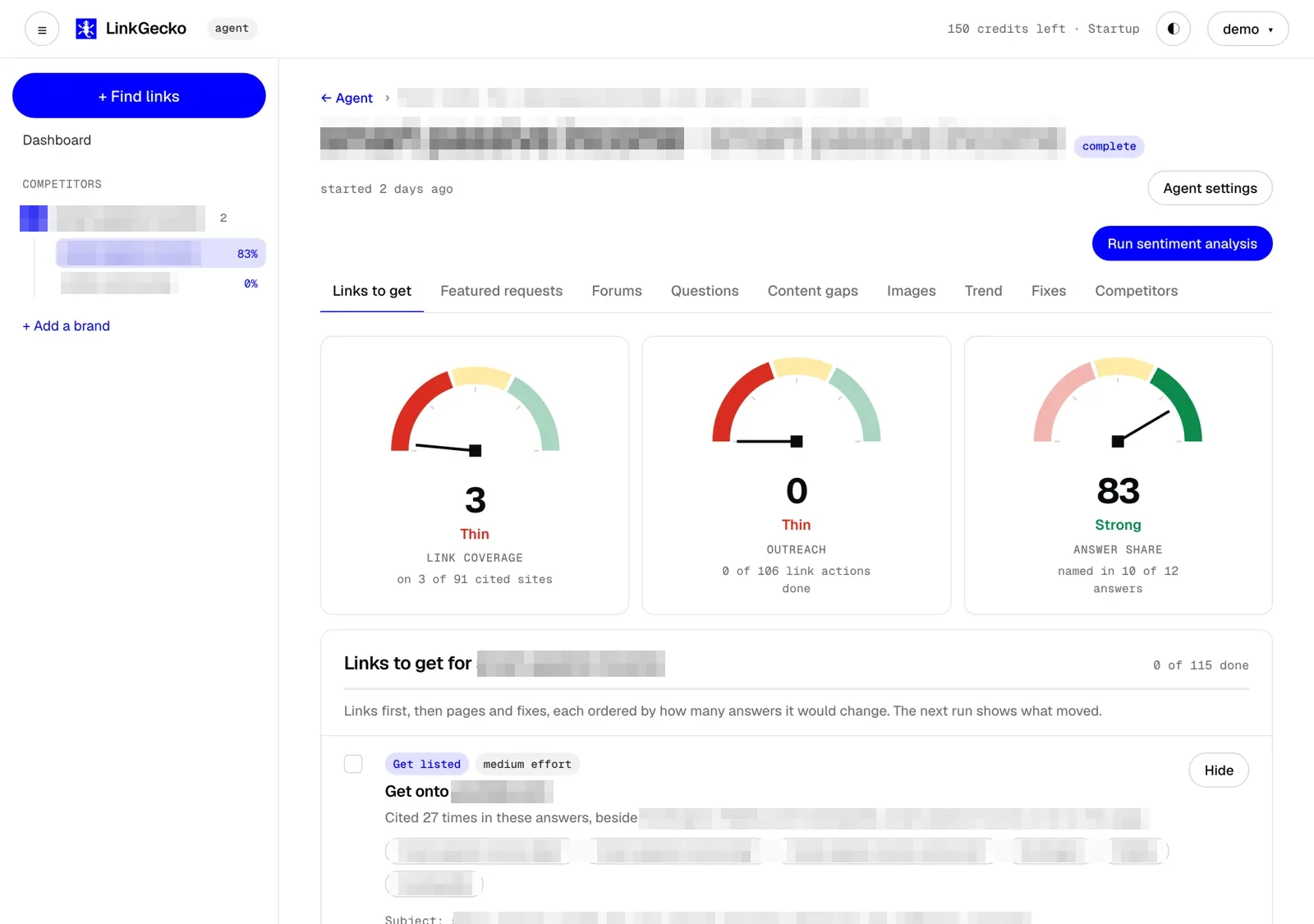
Each week it reruns the questions, tracks which placements went live, and flags the answers that now name your brand. Journalist and podcast requests that fit your product arrive through the link signals feed, which pulls from HARO, Help a B2B Writer and four other sources daily. A reply is drafted when you ask for one.
Pricing is per action. On the Creator plan, 30 credits a month cover one brand analysis, the weekly reruns and about two dozen drafted emails or replies. Reading results never costs a credit.
The Startup plan at $98 covers 150 credits across ten brands, which suits an agency or a portfolio founder. The trial runs seven days with five credits, a card on file and nothing charged on day one.
It does not send the emails, so your reply rate still depends on your sender reputation and how much you edit the draft. Placements are never guaranteed, because no tool controls an editor's decision, and a journalist-facing digital PR campaign still needs a human pitching original data.
A directory package at $99 to $299 buys 100 to 300 submissions, and those directory listings seldom sit among the pages AI answers cite. An agency at $2,500 and up buys the sending as well as the targeting. The software route costs $19 to $297 a month and trades the sending for your own time on the final email.
For a SaaS team that needs fewer than ten placements a month, this route has the lowest cost per attempt on the right pages. The cost per live link then follows your reply rate.
A hybrid works for teams with budget for one retainer line. The agency runs digital PR against journalists, where its relationships pay off, while the list placements and thread replies stay in-house with the tool finding them.
What you own when the engagement ends
Agency contracts rarely spell out what happens to the work when you stop paying. In practice, the prospect list, the editor relationships and the outreach history usually stay with the agency.
Your links remain live, unless they were rented placements that lapse. Everything that would make the next link cheaper leaves with the agency, and whoever comes next starts from a blank spreadsheet.

Before signing, the contract should answer:
- Who owns the prospect list and the outreach records, and can you export them at the end?
- What is the minimum term, and is there a break clause at month three or four?
- Are placements permanent, or do any of them renew on a fee?
Monthly terms with a 30-day notice period exist at some agencies and are worth a small premium. A six-month minimum makes sense only after a paid pilot of three to five links has shown you what their placements look like. BuzzStream's survey found 75% of in-house marketers get six months or less to prove link building's value. A six-month commitment to the wrong agency costs you the whole window.
DIY and software-assisted DIY sidestep the question. The editor who placed you remembers your product, and the pages you have pitched sit in your own tool. When you grow into an agency later, you hand them a warm list instead of a cold one.
When to switch between DIY, agency and in-house
Staying DIY makes sense while you can spend five to ten hours a week on outreach and need fewer than ten new placements a month. It helps if your category's winnable target list is under about 50 pages. Below those lines, an agency's fixed retainer buys capacity you will not use.
Moving to an agency makes sense when you need more than ten placements a month and the outreach hours would come out of someone's real job. It also helps to have done enough outreach yourself to write a quality floor into the contract.
A worked example shows where the lines fall. A SaaS needing five links a month pays roughly $950 to $2,800 in time on DIY, or $2,500 and up on a retainer. A hire costs $7,700 while producing almost nothing yet.
At 15 links a month, DIY needs 20 or more hours a week. The retainer runs $5,000 to $10,000, while the hire costs $7,700 for comparable output with the relationships kept.
| Route | 5 links a month | 15 links a month |
|---|---|---|
| DIY | $950 to $2,800 in time | 20+ hours a week |
| Agency | $2,500 and up | $5,000 to $10,000 |
| In-house | $7,700, almost no output yet | $7,700, relationships kept |
Hiring in-house makes sense when the agency bill passes $8,000 a month for six months running, or when link building joins content and PR in one role.
Moving back from an agency to DIY has a common trigger: a report showing ten links a month on pages your buyers never visit. If your AI answer share has not moved after two quarters, the links are usually landing in the wrong places. A smaller, better-aimed list run by your own team tends to fix it.
Link building agency vs DIY: the verdict for SaaS
For most SaaS companies, DIY link building aimed at the pages AI answers cite beats an agency on cost per live link, relationship ownership and precision. Software that finds those pages and drafts the pitches removes most of the hours that made DIY painful. That makes it the default I recommend below ten placements a month.
An agency earns its retainer when you need volume you cannot produce, a journalist-facing digital PR campaign, or outreach hours your team does not have. Even then, a pilot of a few links and a break clause protect you from paying six months for the wrong pages.
An in-house hire is the right answer once the agency bill rivals a loaded salary, or once link building becomes part of a broader content role.
- Under ten placements a month: software-assisted DIY.
- More than ten, or a digital PR campaign: an agency, after a paid pilot and with a break clause.
- Agency bill past $8,000 a month for six months: an in-house hire.
Whichever route you choose, the test is the cost of one live link on a page your buyers actually read. Running that number before signing anything settles the link building agency vs DIY decision. The cheap option and the expensive one trade places depending on where the links land.
Frequently asked questions
Published retainers run $2,500 to $10,000 a month, with the most common tier at $2,500 to $5,000 for four to ten links, according to BuzzStream's pricing study. That is $250 to $1,250 a link. Digital PR averages $597 a link on a $5,458 monthly contract.
Usually, at small scale. At a specialist's hourly rate of $32.31 (ZipRecruiter), 100 personalized emails cost about $1,130 in time and produce two to six live links, or $190 to $565 a link. DIY loses when your reply rate is poor or your time is worth more than a specialist's.
With five to ten hours a week and a well-aimed list, two to six live links a month is realistic. Reply rates on link building outreach average 3.59% across 51 million emails (BuzzStream), with the median campaign at 12%. Fewer, better-matched pitches raise that rate more than sending volume does.
When you need more than ten quality placements a month and nobody on the team can hold five to ten outreach hours a week. An agency also fits when you want original research pitched to journalists at scale. A paid pilot of three to five links and a break clause before any six-month minimum protect you from paying for the wrong pages.
Mentions matter more. Ahrefs' study of 75,000 brands found branded web mentions correlate 0.664 with AI Overview visibility, versus 0.218 for backlinks. For software queries, 43.8% of the pages ChatGPT cites are best-of lists, so a mention on one of those beats a followed link on a page no answer reads.
Ask who owns the prospect list and outreach records when the contract ends, and whether you can export them. Ask about the minimum term and any break clause, and whether placements are permanent or renew on a fee. The contract should also name the domain rating and traffic floor each link must clear, since only about half of agencies guarantee links at all.
Software-assisted outreach. A tool that finds the review sites, roundups and threads AI answers cite for your category and drafts the pitch costs $19 to $297 a month. You send the emails yourself, so the editor relationship stays with you. The cost per attempt stays far below a retainer.
Most in-house marketers get six months or less to prove link building's value, according to BuzzStream's 2025 trends report. Only 11% of teams have a repeatable process for earning AI citations, per Citation Labs' 2025 survey. The first quarter usually goes to finding the pages that matter rather than winning them.
See which links decide your category
LinkGecko maps the links behind your category's AI answers and helps you build yours, from $19 a month.
Start your free trial